
In San Andreas (beware: spoilers ahead) the seismic upheavals that are the subject of the film hardly touch the family at its centre. Ray, played by The Rock, Dwayne Johnson, manfully flies his Air Rescue Helicopter (which was supposedly on other business, saving other people) in search of his first wife. He plucks her off the top of a high-rise hotel in Los Angeles just in the nick of time. The hotel is becoming rapidly low-rise, along with the rest of Los Angeles, which thrashes and turns and collapses, like the calving of a great glacier. Then Ray and the wife fly off in search of more survivors — or rather, their own survivor, the daughter who is off in San Francisco with her step-dad. On the way they have a meaningful scene about repressed grief and the perils of not opening up — about ‘this’, as the wife says, waving at Ray’s tense jaw — all those tears unshed, all those wails of grief unvented. The backdrop of the touching scene is the wholesale destruction of the West Coast. It falls away beneath them while they sort out their issues. We might just put this down as a failure of the film to do its basic job at providing a credible plot and character motivation (what we get is disasters and mass death situations as the perfect time to think about why I broke up with the wife). But it turns out looking like something worse. The disaster in this disaster movie is narcissism, apocalypse mini-me. It’s a long way from the disaster movies of the 1970s that I’d go in to see on the train from Paremata to Wellington . Towering Infernos in which brave souls rushed down burning hallways answering a cry of help with nothing but a wet blanket to protect them. The flooded corridors of capsized luxury liners through which middle-aged ladies would swim, showing the way out for lesser mortals. These were towering lessons in the moral efficacy of sacrifice; Poseidon demonstrations of heroism. In comparison the couple arguing in the helicopter about the perils of not sharing while the city swallows people alive (other people’s people, mind) leaves me cold. Or over-warm: running through a burning hallway without benefit, even, of soaking blanket.
San Andreas is the disaster movie model of compassion fatigue. The film makes its merry way through disaster: earthquakes are short lived upheavals, but the miseries of divorce drag on and on and it’s the drama of divorce that gets the screen time, even if it doesn’t exercise the special effects.
On the subject of alarms, and films about alarms (or ‘alarums’) let’s consider Force Majeure, a disaster movie of quite another kind. In this, the disaster doesn’t happen. The family on the balcony of a French ski resort see the vasty bank of snow rolling towards them as a spectacle of human mastery of nature, but as the snow cloud looms so close its obliterates the sun they see instead nature run riot, a man-made natural disaster. And fittingly it’s the man who gets up and high tails it from the patio, leaving his wife and two children to their fate. That fate turns out to be just a dusting of snow on the breakfast plates, and the more dastardly problem of their incorporating this new view of the man they love and rely upon as someone who lacks nerve, the capacity for sacrifice, a vital sense of duty. I won’t say much more about the film, which resolves these tensions with brevity, grace and humour, except to highlight one scene. The man goes for a day’s skiing with his hairy-faced, manly-man friend. They go up beyond the highest ski-lifts and off into virgin tracts of snow, and the manly friend — seeing his mate’s misery, his shame — suggests it might be a good idea if he had a good scream. At first, our man can’t quite do it. He produces a stage scream and looks abashed at the effort: even in this he’s found wanting. Then he settles down on his haunches in the snow, turns his face to the distant peaks, and bellows out his woe in a scream so splitting its a wonder it doesn’t bring the whole mountain down.
Screaming is wonderful for venting feelings but as a therapeutic strategy it is flawed, being deaf to itself. Screaming for therapy assumes no one is listening. And perhaps that’s the point. It vents frustration at being misunderstood (‘no one is listening/I am not being heard’).
One cold night in 1984 my friend and I walked up Mount Victoria in Wellington to the town belt, in among the pines where from time to time lonely suicides are found hanging. It’s a dismal place. We’d come straight from a support group, one of those do-it-yourself trauma therapy ensembles that were the thing then. There’d be dogs wandering in and out of the living room, and a single bar heater placed so ineffectually that one person’s jean’s leg would get singed while the rest of us froze. Anyway, that night we were jack of it, so my friend and I took ourselves up to the town belt where we could turn our faces to the city and scream our heads off. We screamed and we screamed and felt so much better for it, so tingling and tired and nosed by jouissance to the edge of the ecstatic that when two policeman came trudging up the slope toward us we met the light of their torches in our faces and their pointed questions with equanimity. We were doing it for the good of our health. A bit of primal screaming, you know? The poor young cops took their caps off and scratched their heads, they looked woeful themselves (in need of a bit of screaming). They’d had people calling in from all over ‘worried that you were being raped, that someone was being killed up here’. No, no, said we—straight from the sexual abuse survivors support group—oh no, we’re quite all right really.
We were let off with a warning, and my diary records we left, ‘amused and chastised’. (I think I meant ‘chastened’, but that ‘chastised’ is telling of how wrapped up in ourselves we were at the time. Chastised is what they do to you. Chastened is how you feel: it’s the learning response to an ethical challenge.)
I don’t know what the police did when they went back to the station, or who talked to whom, or whether one of the concerned residents who had called the police in the first place happened to be a journo, but the newspapers picked up the story. 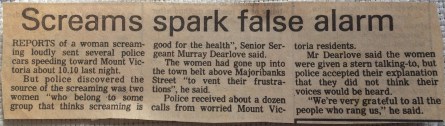 One of the daily papers went the way of ‘chastened’, writing the event as a disturbance, a trammelling of the night ear. The other opted for ‘amused’ with its tongue-in-cheek suggestion that Wellington City Council provide a ‘really isolated, protected screaming stand at the top of Mt Victoria or the Tinakori Hills’.
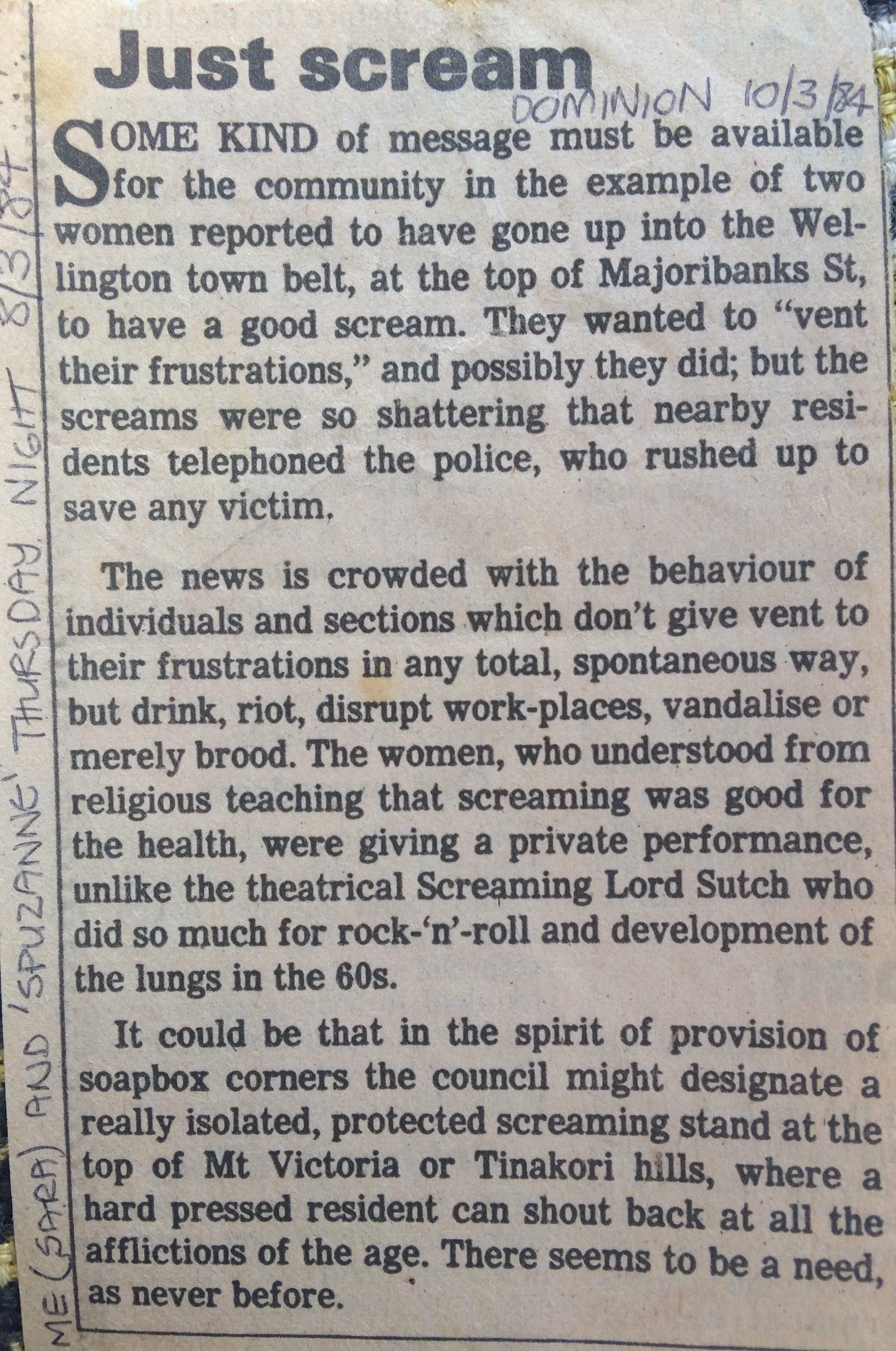 Both seemed to think we’d got the wrong end of the stick about screaming: that ‘religious teaching’ had taught us it was good for the health, or that we were prime examples of the perils of an undergraduate Arts education (taking the word ‘primal’ farther than it ought to go). What amazes me now is that it was remarked upon at all. Which is not to say that screaming now is a daily occurrence but that the how and the what of screaming is very changed. Now the distant peaks to which we turn our faces and at which we scream are Twitter or Youtube (or, erm, WordPress) and there’s not a snowballs chance in hell that scream, however loud, will bring the mountain down on us.
 What I didn't write
This is the loveliest, funniest, stranger than fiction tale cum fable of screaming AND being heard. But not quite.
You can see from below that womens screaming has been historically understood as dangerous to others!
1st November 1928
SCREAMING WOMEN CAUSE MAN’S DEATH
LONDON. Tuesdav.
“These women, screaming about a mouse cost this poor fellow his life and the poor devil of a driver serious injury,” said the Sheffield Coroner in returning a verdict of accidental death at an inquest on a labourer. Two women, seeing a mouse, ran into the street screaming loudly, whereat the driver jumped from a motor lorry behind which a companion was walking. The lorry being on an incline, ran back and struck the men, one of whom died immediately.
LikeLike