Last Words

I am sitting with my mother, staring at the eye chart on the wall opposite the foot of her hospital bed. The bed is very white, both sheets and blanket. My mother is sitting up, and she too is a pale study  — from the washed out hospital gown to the drawn skin of her face. She is tapping the tip of the ballpoint pen on the page of the notepad on her lap: tap–hover–tap — the same gesture she makes when she is using the iPad to compose her end of a conversation. Then, it’s tap–hover–tap because she treats the on-screen keyboard like a typewriter, pecking out letters with her fingernails even as we’re saying ‘Mum, it doesn’t work like that. It has to feel your skin’. She prefers the pen and paper, and in any case the iPad is back in her room in Sprott House, the room to which we will soon be returning to start her dying. In the meantime, we’re waiting for them to rustle up ambulance transport. I have been left to keep her company while my sister Elizabeth arranges things at the Home, things that need arranging with some delicacy. I can’t imagine how difficult that job is in comparison to what I’m doing, sitting there. Difficult certainly with the airlock of mind in catastrophic decompression.

She’s tapping the pen on the page,  and we’re both staring at the eye chart. It’s the best thing in the room, that cascade of letters. Except for the lack of vowels. The lack of vowels is a problem, and that’s why all the tap – tapping is happening. ‘Loped,’ I say, and she nods. She’s already got that one, it’s scrawled on the page before her. She makes her annngh noise and the parts of her face still able to involve themselves in smiling do so: her eyebrows go up, and she drops her chin. That, and the thumbs-up do the work her smile once did. The thumbs up is her gold standard gesture that says a whole range of things from ‘thank you’, to ‘I’m fine, thanks’, to ‘job well done!’. But there’s no thumbs-upping now as one hand needs the pad and the other needs the pen.

She’s found a better word than loped. When I sit forward in my chair and look to see what she’s written, it’s peopled. In the time it takes the patient transport to arrive we get flopped, and all the variations on poled. But the lack of a capital A really is a bugger— a fact on which we agree by pantomime, both of us still staring at the wall opposite the foot of the bed.

I tell this story at the funeral, ten days later. It’s an unprepared eulogy, just as my eulogy for my father eleven years before was unprepared. I stood up and talked and then I sat down again. My sisters had prepared speeches: moving acts of temporary resurrection. Me, I’d been concentrating on the audiovisual presentation: the music, the dissolves, the order of the images. I wasn’t doing the verbal thing. I was still staring at the eye chart at the foot of the hospital bed. I was still gulping in the vacuum outside the mother-ship.

I often think about that interlude in the hospital room, me and mum exercising our scrabble brains on the eye chart. How there were lots of Ds, but no M, or N. Thus, no MND. There was a superfluity of Fs. If pfff was a word we’d have had that down first. But sibilants were out. They’d long since been taken from my mother by the Bulbar Palsy, taken along with the set of her face and its familiar range of expressions; along with speech, laughter, swallowing and—as one of her notebooks observes, the ability to sniff. With all that went the long stories, even if she kept up an engaged—if truncated—commentary on the everyday.

After mum was first diagnosed with MND she’d still beetle about Picton, and later Karori, with a collection of notepads in the cream cloth bag she liked to carry. She’d flip open pages and write what she needed doctors, hairdressers, speech therapists, and a passel of supermarket checkout persons to see. And it was on the pages of those notepads that she carried on her side of conversations with her chatty daughters. Most of these notepads had an all-purpose announcement on the title page: I cannot speak but I can understand you. On the notebook I took from her room the day she died it says simply: lost my voice.

Five years on from her dying, I’m working on an academic article I tend to refer to as ‘that bloody MND paper’. I’ve been working on it for four of those five years and am having a hard time wrestling it down, it being an illness narrative about illness narratives. It’s all rage and white space, and the ending eludes me. Motor Neurone Disease isn’t a great generator of illness narratives by those who are its sufferers. It kills too quickly, and with such scrupulous attention to the symptomatic destruction of so many of the elements of our social being: speech, voice, expression, the ability to eat, move about. (In which order these losses occur depends on which variety of MND). But why are there so relatively few illness narratives written by the nearest and dearest of the dying person? Perhaps because the loss of voice goes two ways, perhaps because we sitters-by-the-bedside are stunned into a kind of silence by that progressive work of demolition.

Scholars  debate what does and doesn’t count as illness narrative on the basis of length, the amount of the work devoted to an account of the illness, the narrative form (memoir, journal, sequence of poems), the who of the narrator (the ill person? Someone near to them?), but generally see them as  giving voice to the suffering body; a ‘return’ of ‘the experiencing, suffering human being from the periphery to the centre of medicine’ (Anne Hunsaker Hawkins, 1999, 13); what Arthur Frank (1995, 16) calls a ‘refusal of narrative surrender’ to medicine. For scholars of illness narrative, the trope of voice is a big thing. And I must admit that gets my goat. So too does the fact that so many illness narratives enact a restitution. The ill person is returned to themselves beyond the chaos of illness, or they’ve made themselves over for the duration of a tenuous survival. (Good for them, I say. I’m certainly not meaning to carp at persons. It’s the genre and its criticism that gets me down.) The illness narrative in general deals poorly with failure, with bad ends: deals badly with ends, full stop. For every Harold Brodsky, blazing down into death, there are a thousand triumphant returns from the purgatory of illness. Which is understandable, given the problem of time. How many of the terminally ill use the last of their time to write about the last of their time? Other than the writers, that is.

In his last book of essays Tony Judt mentally worked out each essay—down to the exact phrasing—over nights spent locked-in a body parcelled neatly for sleep. Judt had MND, although not of the Bulbar Palsy variety. He could see the final lockdown coming on those long nights— not death, but the loss of the means to communicate. The failing of the vocal muscles. The unresponsive hands. The point beyond which every line cast out would find nothing but empty air. In his essay ‘Words’ he writes that ‘talking’ always seemed ‘the point of adult existence.’ And that he’s ‘never lost that sense’ (Judt, 2010, 147). The least sunny part of me—the part still flattened by my mother’s illness—says: never say never. But that would be wrong, and stupidly untrue. Because Judt would have had eager hangers-on to his words right till the end, even if the atrophied vocal muscles sieved them mighty thin. Judt’s nearest and dearest would have understood what he was saying long after everyone else had lost the thread. As did my sisters and I, working translators of mum’s increasingly muddy speech, eager readers and interpreters of the gestures that had become her new shorthand: thumbs-up and little finger-wave.

I often think about us staring at that eye chart, finding words, on the last day before her dying. And now that I’ve been working on that bloody MND paper, I think about Alphonse Daudet at his Alpine Spa, scrutinising the progress of his fellow sufferers’ symptoms to see what he himself had in store: pain and more pain, loss of bodily control, confusion of the senses. But what the acute Daudet also saw was how stubbornly our social bodies make-do. Like the Russian ataxic who’d lost the use of his hands and had to rely upon his servant to roll his cigarettes. When the two fell into an argument—about Daudet knows not what—the servant  made the whole vibrant round of ‘furious gestures’ (Daudet/Barnes, 2002, 67) for the both of them.
‘She was last seen at her own home’

Today, there seem to be no helicopters. The three days since they have been flying grid pattern overhead. I have called the police, and offered my services in the ground search. I have lain awake at night, listening to the lone night-bird whose call I don’t know. I feel pity, and sometimes, panic.

There’s a woman lost in the bushland that borders the mountain suburb in which I live (village really, but that word sounds too English for the pale, dry, unfriendly wilderness that abuts our wilting gardens, our roads from which dust rises in clouds behind the emergency vehicles heading into the reservoir land or the park).

She’s 77, the woman who’s lost. She’s a distant neighbour. I will have seen her at the Rural Fire Service  meeting for residents the last time we had a fire emergency. She would have been sitting on one of those chairs at the front thoughtfully placed for the comfort of the elderly. At other times we might have passed one another on our daily walks, skirting the border between town and the restricted area — the bushland managed by Sydney Water where signs warn walkers that anyone found there will be fined $10,000.

Four days ago she went out for her walk and somehow got lost. The police had one call from her — she could hear the helicopters, she said. But the helicopters couldn’t see her. After that call, her phone battery died. I learn this from the two policemen who are doing a door-to-door in the neighbourhood. It’s late, they say, so they’re doing this instead of the helicopter search. What about sniffer dogs? What about FLIR imaging? I think, but don’t ask these questions. After they have gone, I realise what they meant by late — not late in the day, but too late for her.

The Facebook page for the search is full of the usual kind comments. Hopes. Prayers. Among these, comments from people who knew her — and the route she would take on her solo walks. One neighbour wishes something had been done before, when she used to get lost on a regular basis and ‘we…raced around the neighbourhood looking for her’. Of all the posts this has the most replies. A brief debate about whether it is better to preserve an elderly demented person’s quality of life, and autonomy, or to ensure their safety. The debate is cut off by a reminder that it’s neither the time nor the place for that conversation. All true, it being late, as the policeman said.

The search has moved south-east — toward Narrow Neck and the canyon walls — and I can no longer hear the busy helicopters. Even now, seven days later, they’re still looking, the line of searchers having heard someone call to them: heard the voice, but not been able to tell where it came from.

I don’t like thinking about any of this. And I don’t much like writing about it. But the lost elderly woman, that confused wandering over familiar places become unfamiliar strikes too strong a chord. For I’ve got my own lost woman, though her disappearance is much less dramatic. She was taken from her villa in the retirement facility, wandering, confused, from room to room — looking for her own house from inside it. She is single, and elderly, and childless, so the staff in the hospital — then the respite care home — then the rest home — then another rest home — don’t know what to do with her. We, her nieces and nephews, don’t know what to do with her either, and when we do, no-one listens. So we do what we can. We visit.

When I visit I ask her if she needs anything from the villa (her room in the home is bare and impersonal: there is no part of the person inhabiting it other than the  woman sitting in the armchair by the bed). In a tiny high voice she says the villa is no longer hers. ‘This — all this,’ she says, gesturing around her at the empty room, ‘is mine.’

So I suggest things she might like from the villa. Bra, panties, the book of crosswords. The magnifying glass. More soap. Moisturiser? To everything she whispers, ‘no.’ I have been there all of five minutes when she says it would be better if I leave. ‘Better for you?’ I ask, and finally get a yes. I walk out past the nurses station. There is a heated discussion going on behind the partly closed door. Someone saying it’s all under review. Give it a month. I’m determined to make this the best elderly care facility in the region. I head out to the car park past the unattended reception desk.

I think she asked me to leave because it’s easier to disappear when no one is watching you do it.

The following day I bring in some things for her. Put the clothes in her drawers, the toiletries in the shelves over the sink. Within easy reach on the wheeled table by her armchair I put a tub of moisturiser and the little clock she keeps beside her bed in the villa. She’s hungry all the time, and now she’ll be able to see when to expect morning tea, lunch, afternoon tea, dinner.

‘I used to have one just like that,’ she says, giving the clock a quick, dispassionate look.

‘It’s your clock Aunty Shona,’ I say, ‘I got from the villa.’

She looks puzzled. The villa is lost, and everything in it. She lost it even as she walked around it, looking for it. She lost it when she started to lock the door against visitors; when her suspicions about everyone around her hardened (she’d left notes to herself in a handbag: ‘don’t talk to them. Don’t engage.’) Now she is rationing herself, in that room in the rest home.

When I visit I look for her in that set, tired, blank face. I look and don’t find her.

Angling for a shallow grave in the bush

I have before me the application packet for whole body donation to the medical school of a Sydney University. Living, as I do, in regional New South Wales it’s difficult to find someone to take my usefully dead body—and I don’t want my own university getting it. They’ve got enough out of my living body, without them working my corpse as well. To be punctiliously literal, I wouldn’t be seen dead at my university.

Donating your body to science is an old practice, although those poor stiffs that ended up in the grave-robber’s wheelbarrow in the 1820s didn’t volunteer themselves to the advancement of the anatomical understanding of their betters, those gentlemen gloved in rubber to their elbows to keep the muck off their shirt-cuffs. Now, donating your body to science is the rationalist’s ultimate gesture–the altruistic last turn of a life shuttered by the conviction that the earthly world is it; that the only way we can give the explanations we  still owe the living is by making ourselves empirically useful.

Donating your whole body to science is a  democratic final option, in the sense that programs  for whole body donation don’t discriminate so narrowly about who they’ll take. The question of viability isn’t so pressing as it is in organ donation: one does not need to be an assemblage of harvestable organs, just a body: even an aged body, or a body eaten up by (non-communicable) disease. The one requirement of whole body donation is wholeness, as if those charming sticklers at the receiving centres of medical schools were all St Augustines in disguise, the airside greeters of everything we have been, are, or ever will be. Of course, that the body must be whole means the option isn’t there for amputees to donate, and gift-of-life minded donors  who want to find a useful place for parcel, as well as part, will be out of luck.

My interest in whole body donation is pointed. The only Human Body Farm in the Southern Hemisphere is being established just down the mountains from where I live– handy, since that puts it within the magical 40 km radius of free transport for my corpse to the facility, should the whole of me shuffle off the mortal coil in that vicinity. It is  even possible that the body farm will be more inclusive and accepting of which bodies it takes. Obese people are currently excluded from more run-of-the-mill whole-body donation, but you’d hope the body farm would welcome them. If the purpose of the facility is to advance forensic knowledge about human decomposition, then surely the researchers would want the widest range of bodies they could get. Murder is no respecter of persons and those shallow graves should be open to all. I for one aim to please, to be whole (in body, if not in mind), and trim (though not trimmed)—of a piece, as they say. I’m an excellent candidate for a shallow grave, for mossy skin and beetled brows. I have spent an academic lifetime studying murder, and still keenly feel the sting of a reviewer’s comment that I’d been too partial to my murderers—that by taking their part I’d failed the victims in some signal human way. But when I ‘buy the farm’ (or the farm barters me, for use-value only)  I’ll even all accounts, wipe free all slates. I belong in one of those shallow graves—and aim to be there, in good time.

‘the women understood that screaming is good for the health’

In San Andreas (beware: spoilers ahead) the seismic upheavals that are the subject of the film hardly touch the family at its centre. Ray, played by The Rock, Dwayne Johnson, manfully flies his Air Rescue Helicopter (which was supposedly on other business, saving other people) in search of his first wife. He  plucks her off the top of a high-rise hotel in Los Angeles just in the nick of time. The hotel is becoming rapidly low-rise, along with the rest of Los Angeles, which thrashes and turns and collapses, like the calving of a great glacier.  Then Ray and the wife fly off in search of more survivors — or rather, their own survivor, the daughter who is off in San Francisco with her step-dad.  On the way they have a meaningful scene about repressed grief and the perils of not opening up — about ‘this’, as the wife says, waving at Ray’s tense jaw — all those tears unshed, all those wails of grief unvented.  The backdrop of the touching scene is the wholesale destruction of the West Coast.  It falls away beneath them while they sort out their issues.  We might just put this down as a failure of the film to do its basic job at providing a credible plot and character motivation (what we get is disasters and mass death situations as the perfect time to think about why I broke up with the wife). But it turns out looking like something worse. The disaster in this disaster movie is narcissism, apocalypse mini-me.  It’s a long way from the disaster movies of the 1970s that I’d go in to see on the train from Paremata to Wellington . Towering Infernos in which brave souls rushed down burning hallways answering a cry of help with nothing but a wet blanket to protect them.  The flooded corridors of capsized luxury liners through which middle-aged ladies would swim, showing the way out for lesser mortals. These were towering lessons in the moral efficacy of sacrifice; Poseidon demonstrations of heroism.  In comparison the couple arguing in the helicopter about the perils of not sharing while the city swallows people alive (other people’s people, mind) leaves me  cold. Or over-warm: running through a burning hallway without benefit, even, of soaking blanket.

San Andreas is the disaster movie model of compassion fatigue.   The film makes its merry way through disaster: earthquakes are short lived  upheavals, but the miseries of divorce drag on and on and it’s the drama of divorce that gets the screen time, even if it doesn’t exercise the special effects.

On the subject of alarms, and films about alarms (or ‘alarums’) let’s consider Force Majeure, a disaster movie of quite another kind.  In this, the disaster doesn’t happen. The family on the balcony of a French ski resort see the vasty bank of snow rolling towards them as a spectacle of human mastery of nature, but as the snow cloud looms so close its obliterates the sun they see instead nature run riot, a man-made natural disaster.  And fittingly it’s the man who gets up and high tails it from the patio, leaving his wife and two children to their fate.  That fate turns out to be just a dusting of snow on the breakfast plates, and the more dastardly problem of their incorporating this new view of the man they love and rely upon as someone who lacks nerve, the capacity for sacrifice, a vital sense of duty.  I won’t say much more about the film, which resolves these tensions with brevity, grace and humour,  except to highlight one scene. The man goes for a day’s skiing with his hairy-faced, manly-man friend.  They go up beyond the highest ski-lifts and off into virgin tracts of snow, and the manly friend — seeing his mate’s misery, his shame — suggests it might be a good idea if he had a good scream.  At first, our man can’t quite do it. He produces a stage scream and looks abashed at the effort: even in this he’s found wanting.  Then he settles down on his haunches in the snow, turns his face to the distant peaks, and bellows out his woe in a scream so splitting its a wonder it doesn’t bring the whole mountain down.

Screaming is wonderful for venting feelings but as a therapeutic strategy it is flawed, being deaf to itself.  Screaming for therapy assumes no one is listening. And perhaps that’s the point. It vents frustration at being misunderstood (‘no one is listening/I am not being heard’).

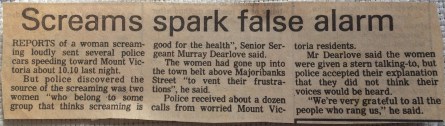
One cold night in 1984 my friend and I walked up Mount Victoria in Wellington to the town belt, in among the pines where from time to time lonely suicides are found hanging.  It’s a dismal place.  We’d come straight from a support group, one of those do-it-yourself trauma therapy ensembles that were the thing then.  There’d be dogs wandering in and out of the living room, and a single bar heater placed so ineffectually that one person’s jean’s leg would get singed while the rest of us froze.   Anyway, that night we were jack of it, so my friend and I took ourselves up to the town belt where we could turn our faces to the city and scream our heads off.  We screamed and we screamed and felt so much better for it, so tingling and tired and nosed by jouissance to the edge of the ecstatic that when two policeman came trudging up the slope toward us we met the light of their torches  in our faces and their pointed questions with equanimity. We were doing it for the good of our health. A bit of primal screaming, you know?  The poor young cops took their caps off and scratched their heads, they looked woeful themselves (in need of a bit of screaming). They’d had people calling in from all over ‘worried that you were being raped, that someone was being killed up here’.  No, no, said we—straight from the sexual abuse survivors support group—oh no, we’re quite all right really.

We were let off with a warning, and my diary records we left, ‘amused and chastised’. (I think I meant ‘chastened’, but that ‘chastised’ is telling of how wrapped up in ourselves we were at the time. Chastised is what they do to you. Chastened is how you feel: it’s the learning response to an ethical challenge.)

I don’t know what the police did when they went back to the station, or who talked to whom, or whether one of the concerned residents who had called the police in the first place happened to be a journo, but the newspapers picked up the story.  IMG_2750 (1)One of the daily papers went the way of ‘chastened’, writing the event as a disturbance, a trammelling of the night ear. The other opted for ‘amused’ with its tongue-in-cheek suggestion that Wellington City Council provide a ‘really isolated, protected screaming stand at the top of Mt Victoria or the Tinakori Hills’.
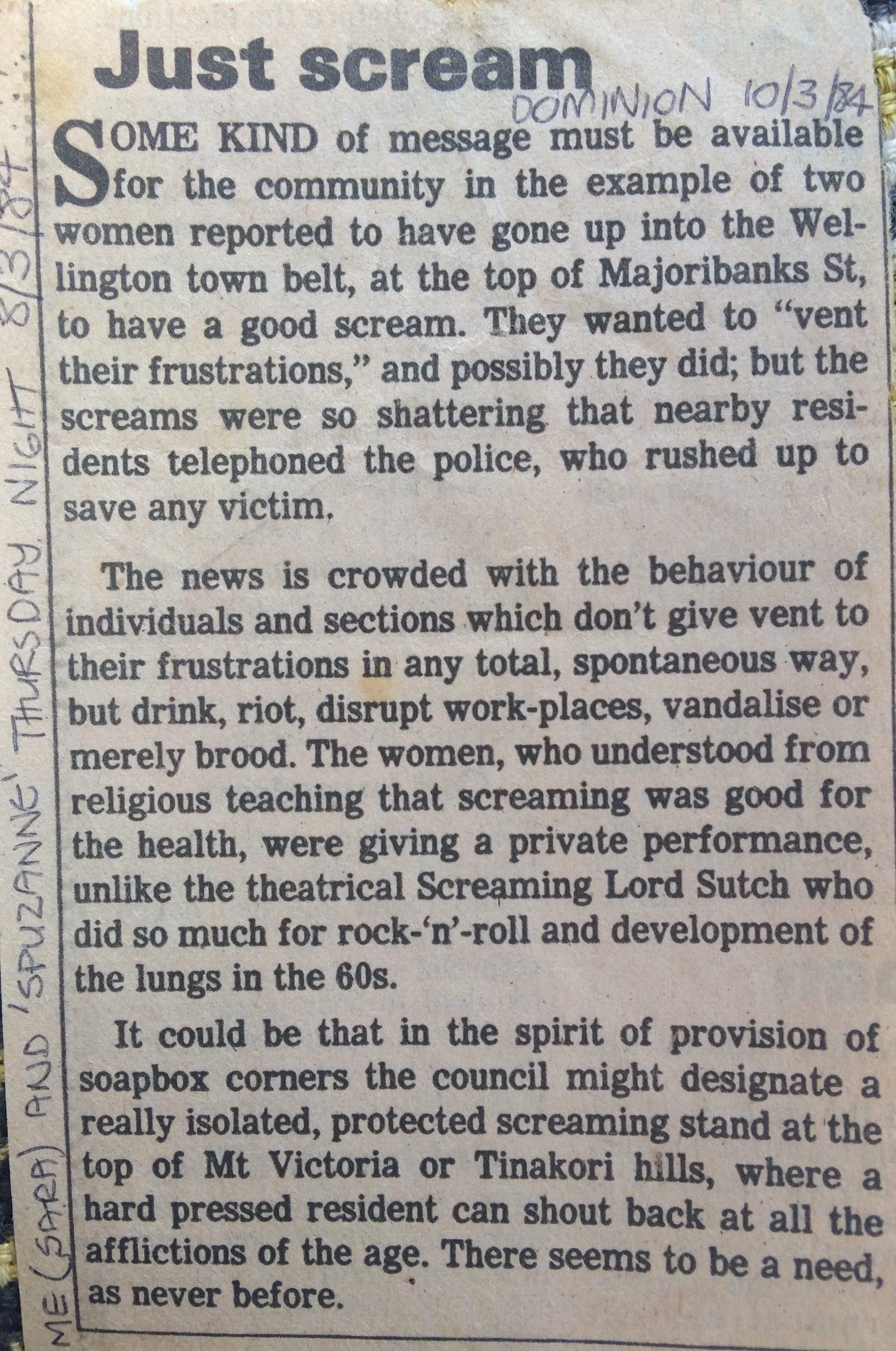
IMG_2749Both seemed to think we’d got the wrong end of the stick about screaming: that ‘religious teaching’ had taught us it was good for the health, or that we were prime examples of the perils of an undergraduate Arts education (taking the word ‘primal’  farther than it ought to go).  What amazes me now is that it was remarked upon at all. Which is not to say that screaming now is a daily occurrence but that the how and the what of screaming is very changed. Now the distant peaks to which we turn our faces and at which we scream are Twitter or Youtube (or, erm, WordPress) and there’s not a snowballs chance in hell that scream, however loud, will  bring the mountain down on us.

‘I have the misfortune to have my discharge burnt’

A couple of years ago ANZAC day coincided with a friend’s birthday celebration.  We were at a swanky restaurant. It was crowded and we sat outside.  On the table next to our’s a young couple were drinking wine and waiting for their meals.  He was wearing the clothes he’d worn to the dawn service — a well-tailored suit—and on the suit jacket breast: ribbons and medals.  In the course of things I heard him explaining to the admiring waiter that they were his great-grandfather’s.  He sat there, basking in the attention.

Everything about that makes me angry. As does the growing trend for the wearing of other people’s ribbons, medallions and medals.  For what’s a medal?  It seems to be taken as a mark of heroic service, ipso facto, but in many cases it’s not an indication of a specific act, but of having been somewhere at a certain time, of coming away from a battle or campaign or a theatre of action.  The medallion doesn’t speak to what you did, just that you were, importantly,  there. Then there are medals for bravery or sacrifice, organised by degree, and they’re relatively rare. The young man wearing his great-grandfather’s medal didn’t seem to know what they meant or what they marked. He couldn’t tell medallion from medal. And he certainly didn’t know  what his great-grandfather thought about medal-wearing.  Had his great-grandfather worn his own medals, or was he one of those men who put the lot away in a trunk in the attic or in a cigarette tin buried in the sock drawer? I don’t know what to make of a trend for proudly wearing something that might have signalled shame or embarrassment to the man who’d earned it.  It’s a very personal thing, a medal — and an analogue of the body in war, the sleepless or wounded body, the body that sits placidly reading in a trench throughout a bombardment, the body that is where it should be, doing what it must do, at the right time.  The medal belongs to the body that comes through.  When people talk about someone getting a medal they say, they pinned a medal on his chest. There’s no mention of jackets there, no fabric to catch the pin. Just skin. The medal marks the body that served.

My grandfather Joe never got his campaign ribbons and medallions of service. Half a century after the war had ended my grandmother wrote a chivvying letter to Australian Central Army War  Records asking them to send them to her. A follow up  from my uncle notes Base Records’ acknowledgment of her letter but says they’ve had no word  since. And no ribbons and medallions bundled into the post.

JEK_5

The reply to my uncle’s letter is not in the service records held by  the Australian War Memorial, comprehensive and eloquent as those records might be.  The enlistment oath and embarkation papers are there, as is a notice to the paymaster of periods ‘non-effective’ (two periods of absence without leave, and when Joe was dismissed the service—non-effective for good and all—on 21 April 1917).  There are the Casualty-Forms on Active Service. These note Joe’s bouts of dysentery in Alexandria and his  stomach ailments in France. The last pages account for his last three months of war. In these, the acronym GSWH comes up repeatedly; sometimes they get specific and it’s GSWLH. He got that wound on the march back to Vaulx after the Battalion was relieved from the  lines in front of Noreuil. The field notes for the Battalion  talk about reverses and lost ground and the ‘enemy well in the rear of our own right’  at Noreuil. That was Joe’s company on the right— ‘A’ Company—who’d been in the front wave of the attack. After a successful counter-attack the following day the Battalion retired with two captured two machine guns and 54 prisoners, but it left more than it took: ‘some hundreds of dead in front of our positions’ (AWM4-23/34/21).

So this is what happened on the road back to Vaulx, three days after the battle: Joe shot himself in the left hand. Gun Shot Wound Left Hand. Period non-effective.

The acronym GSWLH stops the gaps in the service record and it echoes, sub voce, in the silence of those missing replies to my grandmother’s and uncles begging letters. That Base Records did reply is noted by hand on my uncle’s letter, but the reply itself is missing. In more and different words, the reply was GSWLH. Pte. Joseph Edward Knox  never got his medallions and ribbons, and neither did his widow because after two and half years of undistinguished service he’d shot himself in the hand. Joe was a carpenter by trade and I have to wonder at  the desperate sheer bloody guts of his doing that, because while it spared him any more of France and the trenches  it  did for his future too. With that GSWLH  he gave away his job and his family. His niece was a nun and it was her vocation to feel compassion and exercise forgiveness—but still she’d cross the road to avoid him.

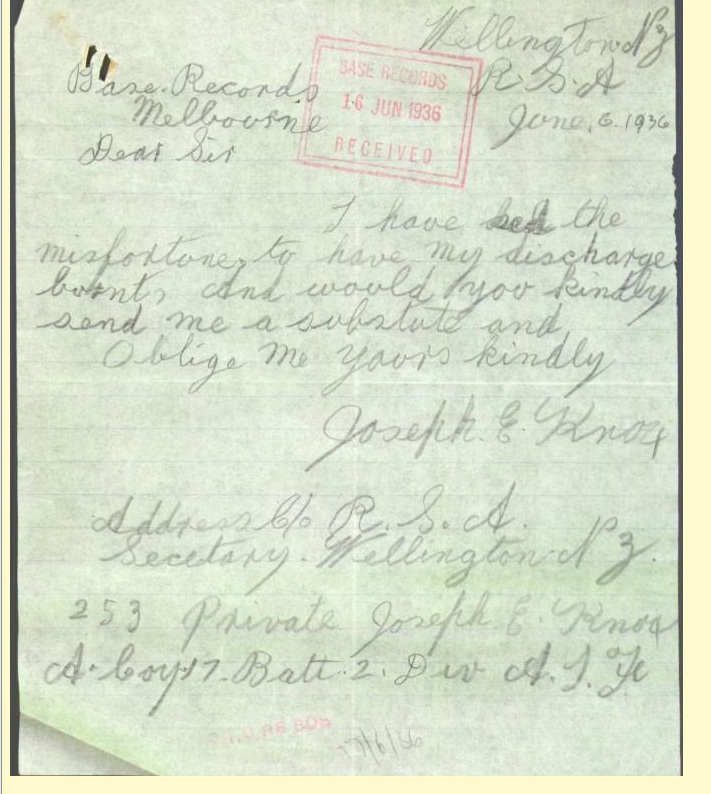
One of the other documents held by the AWM is a letter to Base Records from Joe himself. The  handwriting is shaky, the tone apologetic. The letter is short and self-effacing; it’s as if he’s wishing himself out of existence in the very act of asking that his record be restored.  He’s asking for a copy of his discharge papers, the original being lost: ‘I have the misfortune to have my discharge burnt’. That passive phrasing sounds the retreat.

JEK_6

Who or what did the burning, I wonder. Was it a house fire? He was in and out of mental institutions (he’d eventually die in one) and when he was out, lived in cheap lodging. He was too often drunk. A fire might easily have started by accident. And houses do burn down. But I think it’s more likely that after the base hospitals and the transfers by troop ship back to New Zealand (that quiet drumming out by the AIF), Joe burned the papers himself: put the match to it and watched the back of the paper arch, contract, and at last fall in upon itself as ash.

Teaching out of time: a rejoinder to ‘The building in which I teach’

I wrote ‘The Building in which I Teach’ last year, or a version of it, when  I was having my dark night of the soul, teaching-wise—a state of affairs brought about, weirdly, by an overdose of innovation.  So in this blog I’m writing a rejoinder to myself; a commentary on the woeful tone of that piece.  This is what’s called reflection on teaching practice; it’s  also called taking a more optimistic view of things.

What strikes me about that blog, as a report from the front lines of teaching, is that its shell-shocked tone comes as much from the conditions of my teaching as it does from the students’ learning (or resistance to learning).  I was having my own problems with engagement.  This is what I mean by an overdose of innovation. Making the teaching videos for the unit I’d done my own camera work, had experimented with natural lighting, location shoots and even rudimentary action-cam work;  made  informational skits and built elaborate title sequences with audio and special effects—the whole nine yards to keep myself and the students entertained by the online component of the teaching.  For me, that meant close work with timeline-based video processing software so that I’d come away from a six-hour session in ScreenFlow with headaches, with a pinched nerve in my shoulder or a crick in my neck,  and at night I’d dream up scenes for the next lot of video pods or plot out effects for title sequences. Not since I’d first learned to play chess as kid—and had walked and ate and slept chess moves—had my unconscious been so obsessively engaged. In this case, in a mode of teaching.  I had done all that painstaking  video-processing labour with timelines in the displaced, dis-embedded time of the filmed lesson.  I was in that time, one week ahead of the content, stuck in a scene or obsessing about an effect, which left me out of sync with the real-time of teaching: the face-to-face moment of being there in the room with the students.  It wasn’t that I came to class unprepared — it was that I was somehow not all there, some part of me being stuck in that other-time of the screen.

Feedback on the unit showed that the students experienced the video lecture pods  as talking to them in the moment, and as accessible in the moment (what teaching-and-learning jargon call ‘on-time’ and ‘just in time’ learning), but for me the physical,  intellectual and imaginative labour of making the video lectures had the opposite effect— it was not so much timely and on-time as throwing me out of time. As a mode the purpose-built video lecture  it has its own ontology, and I went through those semesters of innovation in ontological shock: adrift and unstuck from the time of teaching.  I wasn’t in the building where I teach: but not in the way the logic of my teaching nightmares suggests. There’s no widening gulf of water or insurmountable stretch of air between me and the class: there’s just that odd dis-embedding of time and place when teaching goes virtual.

The building in which I teach

They come to class, most of them. Turning up on time, or late, then queuing after the end of teaching to get their names ticked off the roll.  There’s work in turning up and they need it to count, which is why the weeks before the start of semester are hectic, with everyone jockeying for the best timetable they can get.

Then it’s mid-semester. Once again the girl who sits with the girl with the straightened hair—the girl whose phablet is always in or near her hand—has not brought her book of essential readings to class. We have this routine. I lift my eyebrows, and say, ‘So you haven’t got your reader?’ ‘Do I need it?’ she asks, and I walk to the next table, laughing.

One afternoon I’m playing the video lecture pods quietly in the background and the girl who never brings her Reader points at the woman on-screen and says, ‘Who’s that?’  I resist looking around the room: there were fewer laughs at the ‘Who’s that?’ than I’d have expected, which means she’s not the only one who doesn’t recognise the other person lecturing in the course for the last six weeks. They’ll probably write anxious emails to me the night the next assessment is due, saying: ‘I don’t understand the instructions. Tell me what I have to do’. I did tell them what they had to do, at the time—when we were doing that week’s stuff. They sat at their round tables, staring at me as I stepped them through what their portfolio was, and what they have to do, what we expect to see. They were right there when I took them through it. Conversation analysis maybe, or semiotic analysis: Charles Sanders Pierce, he of the long beard and the overblown typology of signs: 60,000 separate elements. But the course makes it simple, going over Peirce’s trichotomy of signs: index, symbol, icon. Three is ok. Three is good. The Holy Trinity of Signs. And when the assessment comes in, I find I’m marking one about Peirce’s tracheotomy. The third time they call it that I write in the margins: ‘Did he do it with the casing of a ball point pen?’, realising as I write that this is what being defeated means, and this is what I’ve sunk to.

Recently, one of my colleagues told me what happened when he was teaching his First Years about metaphor. You should know about this man that he’s a great teacher, he is  clear and engaging whatever he’s teaching—whether it’s Judy Garland and the musical, or the behaviour of the gerund. So, that week he’s teaching metaphor. Loving a good show tune, he plays them Barbara Streisand’s ‘Evergreen’ then asks them to unpack the song’s use of metaphor. But there is no-one in the class who knows that there’s a type of tree called ‘evergreen’—no key, then, to unpack anything.

This is the problem of teaching now. Not what to teach, nor even how to teach: it’s the challenge of teaching when there is nothing to teach to; nothing to hang the ideas off, no language to build on. Not even stories commonly shared. I tend to use the  story of The Titanic in class alot—as analogy,  example or signifying event—as nearly all of my students know what it was, and that it sank. It’s my favourite teaching analogy: that unsinkable ship, that wreck.

It used to be that before the start of a semester I’d have teaching nightmares: that I am late to class, that the tutorial room is in a building in another campus, that the tutorial room is in mid-air, above my head, with no way up to it. Those dreams come more frequently now. In my most recent, I am running to class but get caught in a crowd of people moving in another direction, and when finally they disperse I find I’m on a ferry, and there’s a widening expanse of sea between me and the building in which I teach.