
A couple of years ago ANZAC day coincided with a friend’s birthday celebration. We were at a swanky restaurant. It was crowded and we sat outside. On the table next to our’s a young couple were drinking wine and waiting for their meals. He was wearing the clothes he’d worn to the dawn service — a well-tailored suit—and on the suit jacket breast: ribbons and medals. In the course of things I heard him explaining to the admiring waiter that they were his great-grandfather’s. He sat there, basking in the attention.
Everything about that makes me angry. As does the growing trend for the wearing of other people’s ribbons, medallions and medals. For what’s a medal? It seems to be taken as a mark of heroic service, ipso facto, but in many cases it’s not an indication of a specific act, but of having been somewhere at a certain time, of coming away from a battle or campaign or a theatre of action. The medallion doesn’t speak to what you did, just that you were, importantly, there. Then there are medals for bravery or sacrifice, organised by degree, and they’re relatively rare. The young man wearing his great-grandfather’s medal didn’t seem to know what they meant or what they marked. He couldn’t tell medallion from medal. And he certainly didn’t know what his great-grandfather thought about medal-wearing. Had his great-grandfather worn his own medals, or was he one of those men who put the lot away in a trunk in the attic or in a cigarette tin buried in the sock drawer? I don’t know what to make of a trend for proudly wearing something that might have signalled shame or embarrassment to the man who’d earned it. It’s a very personal thing, a medal — and an analogue of the body in war, the sleepless or wounded body, the body that sits placidly reading in a trench throughout a bombardment, the body that is where it should be, doing what it must do, at the right time. The medal belongs to the body that comes through. When people talk about someone getting a medal they say, they pinned a medal on his chest. There’s no mention of jackets there, no fabric to catch the pin. Just skin. The medal marks the body that served.
My grandfather Joe never got his campaign ribbons and medallions of service. Half a century after the war had ended my grandmother wrote a chivvying letter to Australian Central Army War Records asking them to send them to her. A follow up from my uncle notes Base Records’ acknowledgment of her letter but says they’ve had no word since. And no ribbons and medallions bundled into the post.

The reply to my uncle’s letter is not in the service records held by the Australian War Memorial, comprehensive and eloquent as those records might be. The enlistment oath and embarkation papers are there, as is a notice to the paymaster of periods ‘non-effective’ (two periods of absence without leave, and when Joe was dismissed the service—non-effective for good and all—on 21 April 1917). There are the Casualty-Forms on Active Service. These note Joe’s bouts of dysentery in Alexandria and his stomach ailments in France. The last pages account for his last three months of war. In these, the acronym GSWH comes up repeatedly; sometimes they get specific and it’s GSWLH. He got that wound on the march back to Vaulx after the Battalion was relieved from the lines in front of Noreuil. The field notes for the Battalion talk about reverses and lost ground and the ‘enemy well in the rear of our own right’ at Noreuil. That was Joe’s company on the right— ‘A’ Company—who’d been in the front wave of the attack. After a successful counter-attack the following day the Battalion retired with two captured two machine guns and 54 prisoners, but it left more than it took: ‘some hundreds of dead in front of our positions’ (AWM4-23/34/21).
So this is what happened on the road back to Vaulx, three days after the battle: Joe shot himself in the left hand. Gun Shot Wound Left Hand. Period non-effective.
The acronym GSWLH stops the gaps in the service record and it echoes, sub voce, in the silence of those missing replies to my grandmother’s and uncles begging letters. That Base Records did reply is noted by hand on my uncle’s letter, but the reply itself is missing. In more and different words, the reply was GSWLH. Pte. Joseph Edward Knox never got his medallions and ribbons, and neither did his widow because after two and half years of undistinguished service he’d shot himself in the hand. Joe was a carpenter by trade and I have to wonder at the desperate sheer bloody guts of his doing that, because while it spared him any more of France and the trenches it did for his future too. With that GSWLH he gave away his job and his family. His niece was a nun and it was her vocation to feel compassion and exercise forgiveness—but still she’d cross the road to avoid him.
One of the other documents held by the AWM is a letter to Base Records from Joe himself. The handwriting is shaky, the tone apologetic. The letter is short and self-effacing; it’s as if he’s wishing himself out of existence in the very act of asking that his record be restored. He’s asking for a copy of his discharge papers, the original being lost: ‘I have the misfortune to have my discharge burnt’. That passive phrasing sounds the retreat.
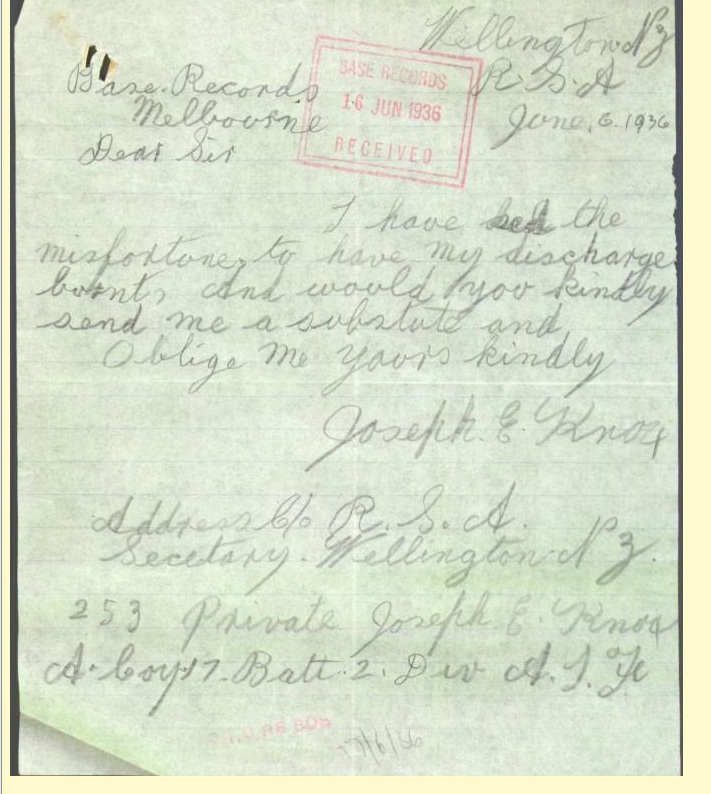
Who or what did the burning, I wonder. Was it a house fire? He was in and out of mental institutions (he’d eventually die in one) and when he was out, lived in cheap lodging. He was too often drunk. A fire might easily have started by accident. And houses do burn down. But I think it’s more likely that after the base hospitals and the transfers by troop ship back to New Zealand (that quiet drumming out by the AIF), Joe burned the papers himself: put the match to it and watched the back of the paper arch, contract, and at last fall in upon itself as ash.
 What I didn't write
Lovely piece. So sad that your uncle was shunned by loved ones for being unable to stomach any more of that horrific war, and that in order to escape it he had to damage himself (as if it hadn’t damaged him already). In stark contrast to that young guy basking in the imaginary reflected glow of his grandfather’s medals: yuck. Trying to claim glory by proxy when his grandfather, as you say, may have felt very differently about those medals.
Our grandpa was a POW in WWII and he almost never spoke about the war – too traumatic. Nowadays I feel quite repelled by the jingoistic stuff that gets trotted out every ANZAC Day. So much of it seems like propaganda, a poor substitute for real thinking or feeling or remembering.
Great that you’ve dug up these family documents to help you piece together your family’s stories. [Sara I see the Otaki letterhead – another geographic connection (besides Paremata/Pauatahanui): our family used to live in Te Horo, in between Otaki and Waikanae.]
LikeLike