‘I have the misfortune to have my discharge burnt’

A couple of years ago ANZAC day coincided with a friend’s birthday celebration.  We were at a swanky restaurant. It was crowded and we sat outside.  On the table next to our’s a young couple were drinking wine and waiting for their meals.  He was wearing the clothes he’d worn to the dawn service — a well-tailored suit—and on the suit jacket breast: ribbons and medals.  In the course of things I heard him explaining to the admiring waiter that they were his great-grandfather’s.  He sat there, basking in the attention.

Everything about that makes me angry. As does the growing trend for the wearing of other people’s ribbons, medallions and medals.  For what’s a medal?  It seems to be taken as a mark of heroic service, ipso facto, but in many cases it’s not an indication of a specific act, but of having been somewhere at a certain time, of coming away from a battle or campaign or a theatre of action.  The medallion doesn’t speak to what you did, just that you were, importantly,  there. Then there are medals for bravery or sacrifice, organised by degree, and they’re relatively rare. The young man wearing his great-grandfather’s medal didn’t seem to know what they meant or what they marked. He couldn’t tell medallion from medal. And he certainly didn’t know  what his great-grandfather thought about medal-wearing.  Had his great-grandfather worn his own medals, or was he one of those men who put the lot away in a trunk in the attic or in a cigarette tin buried in the sock drawer? I don’t know what to make of a trend for proudly wearing something that might have signalled shame or embarrassment to the man who’d earned it.  It’s a very personal thing, a medal — and an analogue of the body in war, the sleepless or wounded body, the body that sits placidly reading in a trench throughout a bombardment, the body that is where it should be, doing what it must do, at the right time.  The medal belongs to the body that comes through.  When people talk about someone getting a medal they say, they pinned a medal on his chest. There’s no mention of jackets there, no fabric to catch the pin. Just skin. The medal marks the body that served.

My grandfather Joe never got his campaign ribbons and medallions of service. Half a century after the war had ended my grandmother wrote a chivvying letter to Australian Central Army War  Records asking them to send them to her. A follow up  from my uncle notes Base Records’ acknowledgment of her letter but says they’ve had no word  since. And no ribbons and medallions bundled into the post.

JEK_5

The reply to my uncle’s letter is not in the service records held by  the Australian War Memorial, comprehensive and eloquent as those records might be.  The enlistment oath and embarkation papers are there, as is a notice to the paymaster of periods ‘non-effective’ (two periods of absence without leave, and when Joe was dismissed the service—non-effective for good and all—on 21 April 1917).  There are the Casualty-Forms on Active Service. These note Joe’s bouts of dysentery in Alexandria and his  stomach ailments in France. The last pages account for his last three months of war. In these, the acronym GSWH comes up repeatedly; sometimes they get specific and it’s GSWLH. He got that wound on the march back to Vaulx after the Battalion was relieved from the  lines in front of Noreuil. The field notes for the Battalion  talk about reverses and lost ground and the ‘enemy well in the rear of our own right’  at Noreuil. That was Joe’s company on the right— ‘A’ Company—who’d been in the front wave of the attack. After a successful counter-attack the following day the Battalion retired with two captured two machine guns and 54 prisoners, but it left more than it took: ‘some hundreds of dead in front of our positions’ (AWM4-23/34/21).

So this is what happened on the road back to Vaulx, three days after the battle: Joe shot himself in the left hand. Gun Shot Wound Left Hand. Period non-effective.

The acronym GSWLH stops the gaps in the service record and it echoes, sub voce, in the silence of those missing replies to my grandmother’s and uncles begging letters. That Base Records did reply is noted by hand on my uncle’s letter, but the reply itself is missing. In more and different words, the reply was GSWLH. Pte. Joseph Edward Knox  never got his medallions and ribbons, and neither did his widow because after two and half years of undistinguished service he’d shot himself in the hand. Joe was a carpenter by trade and I have to wonder at  the desperate sheer bloody guts of his doing that, because while it spared him any more of France and the trenches  it  did for his future too. With that GSWLH  he gave away his job and his family. His niece was a nun and it was her vocation to feel compassion and exercise forgiveness—but still she’d cross the road to avoid him.

One of the other documents held by the AWM is a letter to Base Records from Joe himself. The  handwriting is shaky, the tone apologetic. The letter is short and self-effacing; it’s as if he’s wishing himself out of existence in the very act of asking that his record be restored.  He’s asking for a copy of his discharge papers, the original being lost: ‘I have the misfortune to have my discharge burnt’. That passive phrasing sounds the retreat.
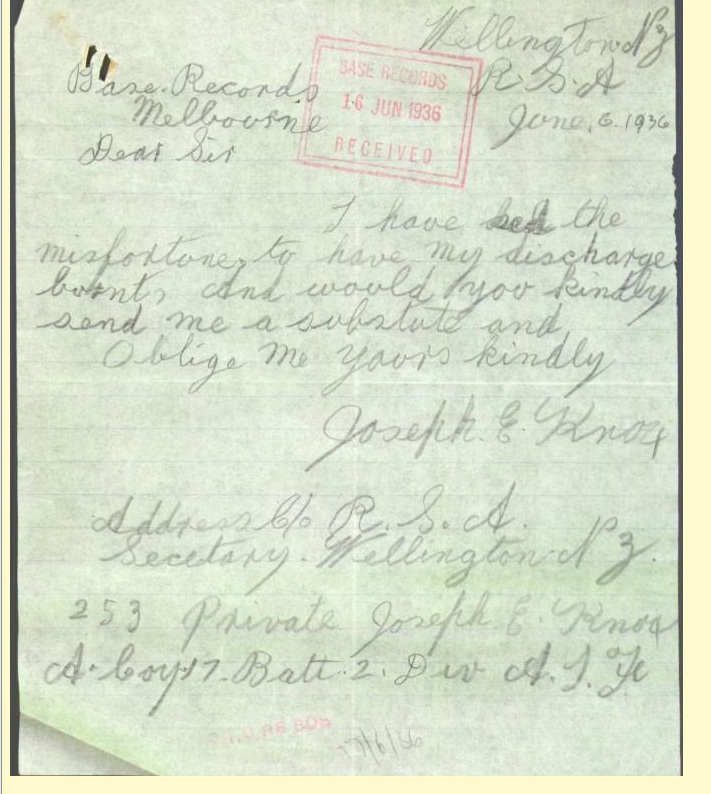
JEK_6

Who or what did the burning, I wonder. Was it a house fire? He was in and out of mental institutions (he’d eventually die in one) and when he was out, lived in cheap lodging. He was too often drunk. A fire might easily have started by accident. And houses do burn down. But I think it’s more likely that after the base hospitals and the transfers by troop ship back to New Zealand (that quiet drumming out by the AIF), Joe burned the papers himself: put the match to it and watched the back of the paper arch, contract, and at last fall in upon itself as ash.

Teaching out of time: a rejoinder to ‘The building in which I teach’

I wrote ‘The Building in which I Teach’ last year, or a version of it, when  I was having my dark night of the soul, teaching-wise—a state of affairs brought about, weirdly, by an overdose of innovation.  So in this blog I’m writing a rejoinder to myself; a commentary on the woeful tone of that piece.  This is what’s called reflection on teaching practice; it’s  also called taking a more optimistic view of things.

What strikes me about that blog, as a report from the front lines of teaching, is that its shell-shocked tone comes as much from the conditions of my teaching as it does from the students’ learning (or resistance to learning).  I was having my own problems with engagement.  This is what I mean by an overdose of innovation. Making the teaching videos for the unit I’d done my own camera work, had experimented with natural lighting, location shoots and even rudimentary action-cam work;  made  informational skits and built elaborate title sequences with audio and special effects—the whole nine yards to keep myself and the students entertained by the online component of the teaching.  For me, that meant close work with timeline-based video processing software so that I’d come away from a six-hour session in ScreenFlow with headaches, with a pinched nerve in my shoulder or a crick in my neck,  and at night I’d dream up scenes for the next lot of video pods or plot out effects for title sequences. Not since I’d first learned to play chess as kid—and had walked and ate and slept chess moves—had my unconscious been so obsessively engaged. In this case, in a mode of teaching.  I had done all that painstaking  video-processing labour with timelines in the displaced, dis-embedded time of the filmed lesson.  I was in that time, one week ahead of the content, stuck in a scene or obsessing about an effect, which left me out of sync with the real-time of teaching: the face-to-face moment of being there in the room with the students.  It wasn’t that I came to class unprepared — it was that I was somehow not all there, some part of me being stuck in that other-time of the screen.

Feedback on the unit showed that the students experienced the video lecture pods  as talking to them in the moment, and as accessible in the moment (what teaching-and-learning jargon call ‘on-time’ and ‘just in time’ learning), but for me the physical,  intellectual and imaginative labour of making the video lectures had the opposite effect— it was not so much timely and on-time as throwing me out of time. As a mode the purpose-built video lecture  it has its own ontology, and I went through those semesters of innovation in ontological shock: adrift and unstuck from the time of teaching.  I wasn’t in the building where I teach: but not in the way the logic of my teaching nightmares suggests. There’s no widening gulf of water or insurmountable stretch of air between me and the class: there’s just that odd dis-embedding of time and place when teaching goes virtual.

The building in which I teach

They come to class, most of them. Turning up on time, or late, then queuing after the end of teaching to get their names ticked off the roll.  There’s work in turning up and they need it to count, which is why the weeks before the start of semester are hectic, with everyone jockeying for the best timetable they can get.

Then it’s mid-semester. Once again the girl who sits with the girl with the straightened hair—the girl whose phablet is always in or near her hand—has not brought her book of essential readings to class. We have this routine. I lift my eyebrows, and say, ‘So you haven’t got your reader?’ ‘Do I need it?’ she asks, and I walk to the next table, laughing.

One afternoon I’m playing the video lecture pods quietly in the background and the girl who never brings her Reader points at the woman on-screen and says, ‘Who’s that?’  I resist looking around the room: there were fewer laughs at the ‘Who’s that?’ than I’d have expected, which means she’s not the only one who doesn’t recognise the other person lecturing in the course for the last six weeks. They’ll probably write anxious emails to me the night the next assessment is due, saying: ‘I don’t understand the instructions. Tell me what I have to do’. I did tell them what they had to do, at the time—when we were doing that week’s stuff. They sat at their round tables, staring at me as I stepped them through what their portfolio was, and what they have to do, what we expect to see. They were right there when I took them through it. Conversation analysis maybe, or semiotic analysis: Charles Sanders Pierce, he of the long beard and the overblown typology of signs: 60,000 separate elements. But the course makes it simple, going over Peirce’s trichotomy of signs: index, symbol, icon. Three is ok. Three is good. The Holy Trinity of Signs. And when the assessment comes in, I find I’m marking one about Peirce’s tracheotomy. The third time they call it that I write in the margins: ‘Did he do it with the casing of a ball point pen?’, realising as I write that this is what being defeated means, and this is what I’ve sunk to.

Recently, one of my colleagues told me what happened when he was teaching his First Years about metaphor. You should know about this man that he’s a great teacher, he is  clear and engaging whatever he’s teaching—whether it’s Judy Garland and the musical, or the behaviour of the gerund. So, that week he’s teaching metaphor. Loving a good show tune, he plays them Barbara Streisand’s ‘Evergreen’ then asks them to unpack the song’s use of metaphor. But there is no-one in the class who knows that there’s a type of tree called ‘evergreen’—no key, then, to unpack anything.

This is the problem of teaching now. Not what to teach, nor even how to teach: it’s the challenge of teaching when there is nothing to teach to; nothing to hang the ideas off, no language to build on. Not even stories commonly shared. I tend to use the  story of The Titanic in class alot—as analogy,  example or signifying event—as nearly all of my students know what it was, and that it sank. It’s my favourite teaching analogy: that unsinkable ship, that wreck.

It used to be that before the start of a semester I’d have teaching nightmares: that I am late to class, that the tutorial room is in a building in another campus, that the tutorial room is in mid-air, above my head, with no way up to it. Those dreams come more frequently now. In my most recent, I am running to class but get caught in a crowd of people moving in another direction, and when finally they disperse I find I’m on a ferry, and there’s a widening expanse of sea between me and the building in which I teach.